
Problem and Solution
Without realizing it, oftentimes players are losing out on profits by only carrying cargo in one direction. Players can double their effectiveness and profit of their trains by carrying cargo in both directions.
The trick is to find a source industry and receiving industry close together at both ends of a reasonable stretch of land.
Example Scenario
A popular cargo to transport for good profit is coal. The coal mine needs to get its coal to a power plant. However, the power plant does not have any cargo to take back to the coal mine. Nor does the coal mine accept any cargo. This means your train carries coal from the mine to the power plant but comes back empty.
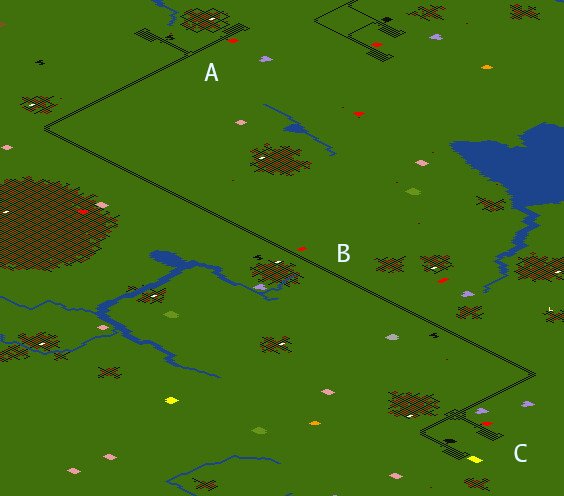
The better method is to find a coal mine/ power plant combo at both ends of the route. That way you can pick up coal at area A and take it to area B. You drop off the coal at power plant B, get paid, and go to mine B nearby and pick up a fresh load of coal from mine B and take it back to power plant A. You can do a full load in both directions and get double the payment!
In this particular example I actually managed to find 2 sets of these so I have A->B / B->A and also B->C / C->B (see screenshot).
Detailed Explanation
Effectively each train is carrying coal in both directions and getting paid both times generating double the profit. – No traveling back empty.
It is fairly easy to find a bi-direction situation you can take advantage of. In the screenshot I show a rare scenario in which I managed to find a double bi-directional situation – kind of rare. In this case I used 3 stations for Power Plants and 3 for Coal Mines.
Another advantage to this setup is shared track. I used a ‘trunk line’ where every train can get to every station. Using Ro-Ro stations and one way path signals helps avoid bottle necks.
Backhaul Strategy Explained
The Backhaul Strategy (or Full-Load Return Loop) is the ultimate way to double your track efficiency. In vanilla OpenTTD, letting a train run empty on its return leg is wasted profit. By hauling cargo in both directions, you maximize your income while keeping infrastructure costs exactly the same.
1. Core Mechanics: OpenTTD vs. Old TTD
If you played the original Transport Tycoon Deluxe, you might remember mixed-cargo trains gridlocking stations. OpenTTD introduces two massive quality-of-life features that make backhauling flawless.
Explicit Order Stacking
You can now separate unloading and loading into two distinct steps at the exact same station. This prevents trains from getting stuck trying to load cargo before they have completely emptied their wagons.
The Depot Refit Feature
You do not need to split your train half-and-half with different wagon types. Certain wagons (like Boxcars) can carry multiple cargo types. You can order a train to change its cargo type at a station or nearby depot on the fly, giving you 100% hauling capacity in both directions.
2. Best Vanilla Backhaul Combinations
You can set up backhaul routes using symmetric raw materials or by utilizing shared wagon types.
Pure Raw Material Loops (Easiest)
These industries require zero setup lines. They produce materials independently. You can link them point-to-point immediately.
| Commodity | Industry A | Industry B | Industry C | Industry D |
|---|---|---|---|---|
| Coal * | Coal Mine A | Power Plant B | Coal Mine B | Power Plant A |
| Iron Ore | Iron Ore A | Steel Mill B | Iron Ore B | Steel Mill A |
| Wood | Forest A | Sawmill B | Forest B | Sawmill A |
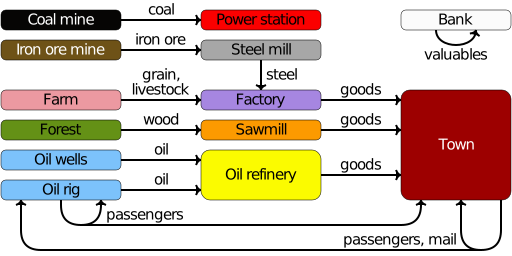
Note: Coal is the only commodity that does not cause a byproduct to be produced that also needs to be delivered. Wood from a forest taken to a sawmill produces goods, iron ore from an mine taken to a steel mill produces steel, etc. So even though these other commodities produce secondary products you can opt to just transport the original commodity.
Then again, goods could be transported to a town or city, steel can be delivered to a factory, etc. (see below)
Symmetric Town Loops
These cargoes are both produced and accepted by towns or city structures.
- Passengers: Town A ↔ Town B
- Mail: Town A ↔ Town B
- Valuables: Bank A ↔ Bank B (Temperate climate only)
Refit & Mixed-Cargo Loops (Advanced)
These require a single train to carry different cargo types on each leg.
- The Livestock & Goods Loop: Use Boxcars. Load Livestock at Farm → Deliver to Factory. Refit to Goods at Factory → Deliver to Town near original Farm.
- The Grain & Steel Loop: Requires a split train (half grain hoppers, half flatbeds). Grain to Factory → Steel back to a secondary industry hub.
3. Step-by-Step Order Configuration
To prevent station lockups, use this exact order template in your train’s routing menu.
For Same-Cargo Loops (e.g., Coal to Coal)
Go to Mine A→ Full load all cargoGo to Power Station B→ Unload all and no loadingGo to Mine B→ Full load all cargoGo to Power Station A→ Unload all and no loading
For Refit Loops (e.g., Livestock to Goods using Boxcars)
Go to Farm A→ Full load all cargo (Wagons automatically/manually set to Livestock)Go to Factory B→ Unload all and no loadingGo to Factory B→ Refit to GoodsGo to Factory B→ Full load all cargoGo to Town A Station→ Unload all and no loadingGo to Farm A→ Refit to Livestock
4. Advanced Pro-Tips for Your Network
Use the “Transfer” Hop for Clogged Cities
Do not force your massive mainline backhaul trains into cramped city centers just to drop off Goods. Deliver the Goods to a rural hub station near your farms using the Transfer and leave empty command. Use local trucks or small feeder trains to bring the Goods the final mile into the city.
Watch the Station Ratings
When a train is performing a long backhaul journey, it is away from the primary industry for a longer period of time.
- Use at least two trains on a backhaul loop.
- This ensures a train arrives frequently enough to keep the station rating high.
- Low station ratings cause the industry to decrease production over time.
The FIRS NewGRF Synergy
If you graduate from vanilla to the FIRS Industry Set, this strategy becomes mandatory. You can use large trains to haul heavy raw materials one way, and use fast helicopters to backhaul the resulting Engineering or Farm Supplies directly back to the primary mines to skyrocket their production rates.